Whoever dispenses food will first have to package it, which is why Marita de Vries of WeLLDesign took a look at the Food Valley Summit on 7 December.
At WeLLDesign, food dispensing is one of our main focuses. Topics at the Food Valley Summit include societal trends and developments that food packaging must respond to, revolutionary materials, and smart packaging, primarily aimed at reducing food waste.
Marita: ‘For me, a main goal of the day is to gain insight into the most sustainable developments in the field of food packaging. Every European opens five packages a day, 1,800 a year. That is something you have to think about as a designer. Should we then stop packaging our food entirely? Is that plastic wrap around the cucumber really necessary? Yes! After all, cucumbers can be kept two days longer that way. The energy from food production outweighs the emissions of that piece of plastic by a factor of ten.’

So sustainability is not just about saving on plastic, but involves other matters too. Packaging also determines the meaning of the product for the customer. The brand must tell a distinctive story. Today's moderator, Andy Mosmans, talks about the ten Ps that can make a positive difference in packaging:
- Plug, due to the rise of e-commerce
- Pure, because we love seeing unpacked food, and feel bad about throwing away all those single-use plastics. Less is more.
- Price, that must always be low for packaging because it is all about the contents.
- Place, where the product is sold, as an additional experience with the packaging.
- Portfolio, of the product line, distinctive from competitors as a whole.
- Produce, of the packaging, such as the mushroom box made from mushroom mycelium
- Purpose, repurposed for the circular economy
Food packaging trends
Ger Standhardt (NVC) discusses global trends and their influence on packaging requirements for businesses. Demographically, this concerns urbanisation, the disappearance of kitchen gardens and the need for an extensive supply chain. Households are getting smaller—we have 2 children instead of 6, which is changing packaging sizes—and society is ageing. With the diminishing physical strength of the elderly, packaging needs to be produced so that it is more accessible.
As society digitisers, we would like to reduce the volume of parcels. This allows e-commerce to be shipped more efficiently and for the parcel to be delivered through the letterbox, for example. Instead of making the outside of the packaging look attractive, the information and marketing must now be on the inside to provide a surprise upon receipt.

Finally, Sanjeev Das of Unilever shares a story about the commercial side of packaging, where logistics present the biggest challenges. Timing and speed are paramount, and the packaging material must prevent leaks, including during the ‘last mile’ delivery to the doorstep. In the Netherlands, this is done neatly in vans, but in India, large stacks secured with ropes are carried on the back of bicycles, and things occasionally fall off. The previous Thai speaker talks about special public drop-off lockers for parcel delivery in her country. This is necessary because people are rarely at home when working 12 hours a day. Consumers are increasingly keen to make environmentally conscious choices. They want to know where their food comes from and dislike what they see as unnecessary packaging. Dr Pongsuda Pongtanya of Thai-based SCG Packaging mentions this too. Health and food safety are high on the customer's wish list. They know more and more about nutritional values, are better educated, and want to see that reflected on the packaging. There are various types of active packaging on the market that ensure this food safety for the customer and aim to combat food waste. Think of oxygen levels, antibacterial materials, the influence of temperature, and the moisture absorption of the packaging.
Revolutionary materials
To combat food waste, a number of smart materials can be applied. The Swedish Felix Helander of Packbridge talks about the major improvement in food shelf life when packaged in the transparent, 3-layer GL film. Developments we are moving towards are lower weights, stronger, more sustainable and smarter materials. Stronger materials are achieved through nanomaterials or the use of the very expensive graphite. Graphite is pure carbon and is used in the sealing of pill packaging because of its water resistance.
Examples of sustainable developments include Scanfill bio-film made from 45% recycled material, Tetra Pak made from sugar, and the compostable material GAIA. The benefits of biodegradable plastic must always be weighed up, as it often requires more energy to produce and cannot subsequently be recycled alongside other plastics. PEF (polyethylene furanoate) is of 100% biological origin, and Ecover contains 50% ocean plastic.
Smart packaging can have an element that degrades at the same rate as the product it contains, such as the gelatinous Mimica touch. Colour-changing labels on meat can indicate its shelf life (Insignia technology), or the barcode becomes unreadable and the product unsellable when the cold chain is being disconnected (Tempix).
A number of speakers talk about the revolutionary material they are bringing to the market:
- Dick Gehéniau (Shieltronics): Shiefronfoil guarantees homogeneous heating of the packaging contents
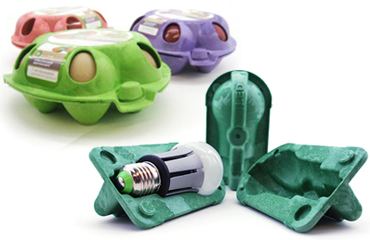
- Mark Geerts (Paperfoam): The most sustainable egg cartons made from injection-moulded starch (potato processing waste) and natural fibres.
- Timmo Terpstra (Peeze coffee roasters) talks about the way they fit into the circular economy (Figure 3) by using the coffee grounds in the coffee packaging and as a growth medium for cultivating oyster mushrooms.

- Victor Monster (Liquidseal): Liquidseal is a liquid layer on fruit and vegetables that passively protects against spoilage to prevent food waste. It is biodegradable and can be applied to inedible peelings.
- Ivo Hendriks (PerfoTec): Tiny holes are perforated in fruit, vegetable and flower packaging based on 6 measurements of the respiration rate of each individual species.
To find out which solution is actually the most sustainable, measurements need to be taken. A life cycle assessment is the sustainability assessment of a product or service, set out across various stages of the product's life. Depending on the stage that consumes the most energy, the most efficient sustainability improvements are sought. Agnieszka van Batavia from The LCA Centre explains that for this reason, at festivals, the polypropylene beer glass is more sustainable than one made of glass or biodegradable PLA, when looking at the production, transport, use, and recycling of the material. The order in which the circular economy should be implemented with products is saving, reusing, recycling materials, and only as a last resort, replacement.
Smart packaging
To prevent food residue from being left behind in the packaging, Liqui-glide is a good solution. Eef de Ferrante of AIPIA talks about food waste, which according to him is the responsibility of the entire supply chain. Smart systems are being used to counter this. Customers constantly use their phones in shops, which can also be utilised with RFID, QR, augmented reality, NFC and beacons. Data is collected when the customer scans, showing who, when and where the product is viewed, which is extremely valuable for the manufacturer. Electronic paper (E-ink), like an e-reader, can display changing text on packaging.
Jenneke Heising is conducting academic research into smart and active packaging. For example, there is oxygen-absorbing material (steel powder), which can extend the shelf life as antibacterial packaging. Substances of this kind must be released gradually for the longest shelf life. Sacco de Linter Hekkert will tell us more about this, illustrated by charts.
During the drinks reception, I speak with Asian and European producers about the applications and innovation opportunities we at WeLLDesign are looking for. They wish me the best of luck in finding unfindables and we bring the day to a nice close.




 Nederlands
  English (UK)