
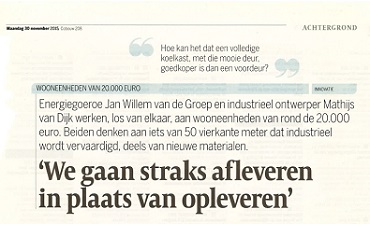
We are going to deliver new housing
An important part of realising new living concepts requires the art of finding investors. The owners of existing building projects are not interested in ‘budget’. “We have to construct homes that are so attractive and so inexpensive that consumers simply want them” summarizes Mathijs van Dijk.
“In the home building industry the process of industrialisation is still very traditional” says Mathijs van Dijk. Companies do produce factory-made prefab elements, but this is very similar to what was constructed on the building premises up till now.
Deployment of robots has to be taken seriously. Where needed we have to introduce new materials. MorgenWonen home In the building industry, the term ‘additional work’ will cease to exist. From now on we call that ‘options’ according to van Dijk. And we will end to ‘supply’ a home to a customer. This term implies that we show the product to the customer and hope that he will not notice mistakes, faults and omissions. The term ‘delivery’ means getting the (finished) product to the customer, like delivering a refrigerator. Simple, ready to go, OK.
Google and IKEA
When asked how he intends to bring about his plans, Van Dijk answers that he expects more interest from outside the construction sector. “Perhaps Google sees the opportunities. Or Ikea.” The vision of Van Dijk and Jand Willem van de Groep is clear, but the how is certainly not yet. Both gather students of all stripes – think of aerospace, but also the social sector – around them to arrive at a truly innovative concept together. Both shy away from terms like ‘house’, because that could push their think tank in a certain direction. They expect a lot from robotisation and new materials and think that a great deal still needs to happen in these areas before construction can take a genuinely innovative step.
Traditional renewal
Companies do make prefabricated elements in factories, but they do so in almost the same way as they used to on the construction site.
“The industrialisation of construction has been very traditional so far,” says Van Dijk. “Companies do make prefabricated elements in factories, but they do so in almost the same way as it was previously done on the building site. There needs to be serious robotisation. And where necessary, we will have to use new materials.”
Here, Van Dijk is thinking of thermoplastic composites, for example, which, depending on the processing, can be hard or soft and more or less porous. “You then have to industrialise incredibly, so that you can make moulds and dies to produce more cheaply. If you build one Senseo machine, it costs about 25,000 euros. But if you invest 1 million in moulds and dies, then each subsequent machine costs 25 euros. And that is how the construction sector must also start thinking.”
Playmobil
I'm not against traditional materials, we just have to look at what application they are still suitable for
When asked what kind of new material a facade, for example, should be made of, Van Dijk does not come up with a clear answer. He agrees that the current construction is not so crazy after all: a wind and rain screen on the outside, something with a lot of air for insulation in the middle, and something hard on the inside to hang a little painting on. “Nor am I against traditional materials,” Van Dijk assures. “We just need to look at what application they are still suitable for – and then assemble them more cleverly there. We are going from lego to playmobil. So no more building blocks, but complete elements.”
Van de Groep certainly has clear expectations of a shift in materials, particularly towards composites. “In aerospace and the automotive industry they are already widely used, whereas in construction not at all. We are indoctrinated by concrete and steel. Whenever new things are tried out, such as 3D printing, we immediately think we have to do that in those materials. While the new
production methods actually offer opportunities for new materialisation and dimensioning. And in combination that means a different scale and better and cheaper materials.”
Options
Shortly we are going to deliver, just like a fridge. Simple, ready, and good
Extra work won't exist soon. “We call those ‘options’,“ according to Van Dijk. ‘And we're also going to stop delivering. ’Delivering' is showing your product to the customer and hoping they don't notice the mistakes. Soon we're going to deliver, just like a fridge. Simple, straightforward and good.”
Van de Groep also has one more point to make about the fridge, namely that it is a very well-designed appliance, with a highly insulated door that opens and closes easily. “And it costs around 600 euros. How is it possible that a complete fridge, with that lovely door, is cheaper than a front door for a house?”
He answers himself: “Because people don’t look around them enough. There are solutions available in other industries that we simply overlook in construction. Or someone uses something once, but it isn’t scaled up, because construction projects are by definition not made scalable and because the people who worked on them quietly start all over again next time. From scratch.”
Two rolls
The home designer will soon have two roles: 1. Creating the basic design
2. Modifying this base model together with the customer into a bespoke home. Since this home is manufactured in a fully industrialised way, straight from the computer model by six-axis robots, minor adjustments do not have to cost more, in either time or money. And because we are using different materials than we do now, notably many composites, it can be better, cheaper and on a different scale.


 Nederlands
  English (UK)